
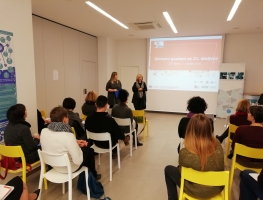
On the 8th of February, Centre of technical Culture Rijeka hosted the event “Global Citizens for the 21st Century” in Rijeka, Croatia. Various lecturers explained the concept of Global Citizenship and its importance, as well as how to educate and raise responsible, active global citizens. They outlined the steps already made to ensure the successful education of responsible global citizens, and presented the examples of good practice from Croatia.
Bojana Ćulum, Associate professor on the Department of Education of the Faculty of Humanities and Social Sciences in Rijeka, held an introductory lecture on Global Citizens for the 21st Century. The representatives from formal and informal education were informed about Global Citizenship Education. They were inspired by the idea of transformative and emancipative education, that has the potential to create students that understand social, economic, cultural, political and ecological systems that have critical thinking skills and understand how to promote positive and sustainable interaction with their local and global surroundings.
Lana Golob and Mirela Pašić, from the Department of Education and Schooling of the City of Rijeka, presented the Citizen Education model of the City of Rijeka, that was experimentally implemented during the last school year in 6 schools in Rijeka. This year the citizenship education is included in 22 elementary schools in Rijeka. The evaluation of the last year’s experimental phase shows positive change in student attitudes. Also, the City of Rijeka has signed an agreement with the City of Sisak and Primorje-Gorski kotar County, and will disseminate all the educational materials. The initiative for implementing Citizenship Education in schools does not end there, as they are planning to introduce the Citizenship Education model to high schools.
The curricular reform in Croatia is proving to be controversial. The reform is opposed on many sides, and advocated by other. Centre for Peace Studies is one of its strongest proponents. Lana Jurman from Centre for Peace Studies presented their perspective on the Global Citizenship Education, and the different ways of its application in the context of formal, non-formal and informal education. They just enrolled the 20th generation of students in peace studies and have various educational programmes for elementary and high school teachers. They are creating didactic materials and publications, and lead initiatives such as the Taste of Home cooperative or the “Colourful Stories” picture book.
Diana Kovačić, from the NGO Žmergo, from Opatija, presented the EAThink2015 project, that lasted from 2015 to 2017 and included over 7 400 students, 5 300 parents and 900 teachers and professors. The project was based around building school gardens, organising actions for raising environmental awareness and education about sustainable way of life. They ensured the continuation of the project, now named “A Plateful of Goodness”, on the national level by successfully applying for funding at the Ministry of Science and Education.
The closing lecture was reserved for Hana Galogaža from CTC Rijeka, who presented the BRIGHTS blended course, open to all interested in teaching Global Citizenship Education to young people using the methodology of digital storytelling. Digital storytelling uses digital tools and encourages young people to share their stories about the challenges of the contemporary society while using the ever present online platforms. The first phase of the course is online based, and starts on March 5th